Calendar Conversion
How to Chart a Leap Lunar Month
A leap month is an extra month in the lunar calendar, not an extra pillar in Ba Zi. Month Pillars follow solar terms. Convert the leap date to a solar moment, then see which term-month it lands in.
TianJiGe Editorial TeamUpdated
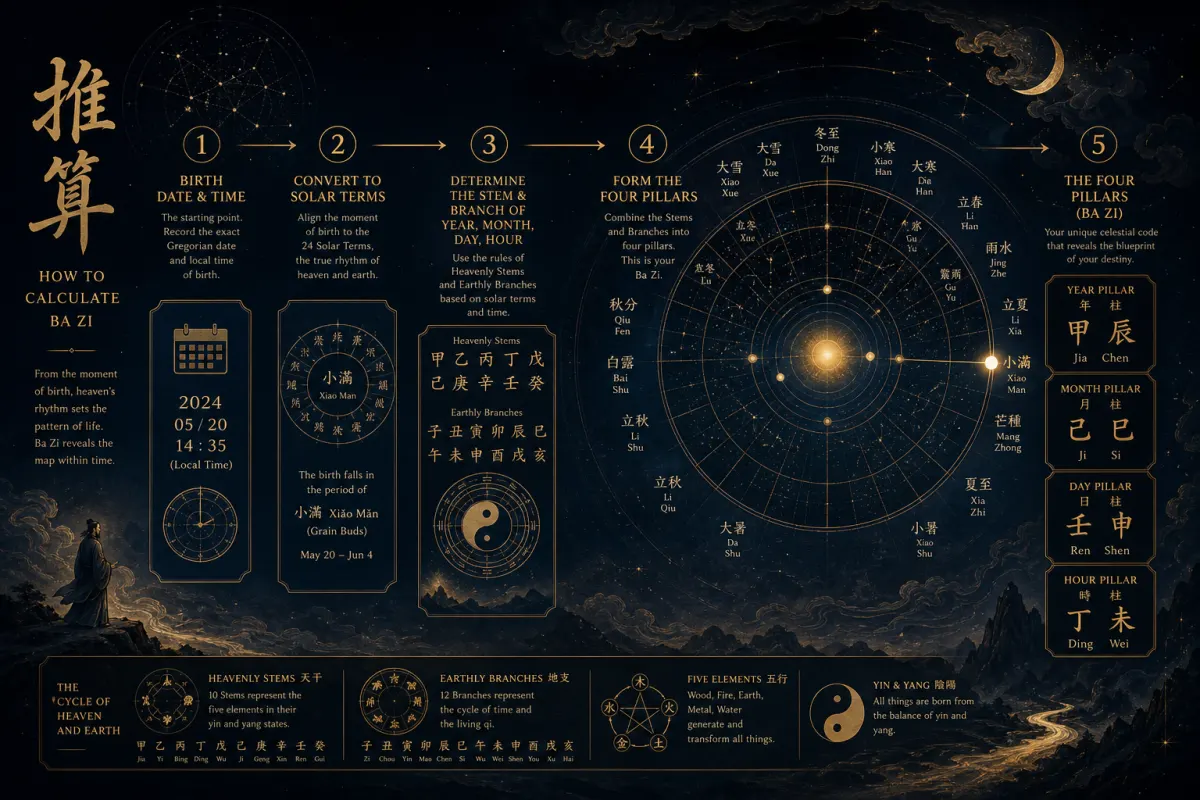
If the birthday is a leap lunar date, choose lunar input and mark the leap month so the system converts to solar time first. Do not treat 'leap April' as April or as the Si month. After conversion, year follows Li Chun and month follows solar terms—the same rules as a solar chart.
A leap month is extra on the calendar, not extra in the chart
The Chinese lunar calendar tracks new moons, resulting in about 354 days per regular 12-month lunar year—roughly 11 days shorter than the 365.24-day solar year. To keep seasons aligned, a leap (intercalary) month is inserted 7 times every 19 years. For example, 'Leap April' follows regular April, repeating calendar dates without adding a 13th stem-branch pillar to Ba Zi.
In Four Pillars astrology, Month Pillars are strictly demarcated by the 12 major solar nodes (Jie) of the 24 Solar Terms: Yin starts at Li Chun, Mao at Jing Zhe, Chen at Qing Ming, Si at Li Xia, Wu at Mang Zhong, and so forth. Month transitions are completely independent of lunar first-of-month days.
The most common mistake is assuming 'Leap April' is automatically the Si month or treating it as the following month. The Month Pillar sets the seasonal command (Yue Ling) of the entire chart; miscalculating it invalidates Day Master strength and all Ten Gods configurations.
Order: leap lunar date → solar moment → term month
Step 1: Confirm the lunar year, month, date, and leap status. In leap years, regular month X and leap month X are roughly 29 to 30 solar days apart; missing the leap flag shifts the underlying solar date by nearly an entire month.
Step 2: Convert the leap lunar date into a standardized Gregorian solar timestamp (year, month, day, and time) using an astronomical perpetual calendar.
Step 3: Check which solar term the Gregorian date falls under. For example, for a 'Leap April' birthday: if the solar date falls before 'Mang Zhong' (around June 5–6), the Month Pillar is still 【Si month】; if it falls after Mang Zhong, it enters 【Wu month】. The true Month Pillar depends entirely on the solar term position.
Step 4: The Hour Pillar continues to follow standard two-hour branch intervals. A leap month alters the solar day of birth, not the rules governing hours within that day.
When the family only remembers 'leap May'
Family records and elders often recall birthdays purely in traditional form, such as 'Leap May, 6th day', without knowing the Gregorian equivalent. Do not arbitrarily convert this into regular May or June.
In TianJiGe, select 'Lunar' calendar mode and choose the month marked with 'Leap' (e.g. 'Leap May'). The system automatically computes the astronomical solar conversion and applies the correct solar term boundaries.
If using basic calculators without leap month support, consult a verified perpetual calendar first to convert the date to its exact Gregorian equivalent, then chart using solar input.
Two checks after the chart appears
First, verify the 【Year Pillar】: For births near the lunar new year or winter leap months, verify the Year Pillar against 'Li Chun' (Start of Spring), not Chinese New Year's Day (Spring Festival).
Second, verify the 【Month Pillar】: Ensure the month branch stems from the active solar term rather than the lunar month name. Lunar 'May' is not synonymous with 'Wu month', and 'Leap May' must not be arbitrarily assigned to Wei or Wu.
Once Year and Month pillars align with solar terms, Day and Hour pillars are interpreted under standard rules. A leap month is an astronomical calendar mechanism, not a predictor of unique fortune or destiny.
How to Get Started
- 1Confirm lunar calendar type and verify that the month was indeed a leap month that year.
- 2Select lunar input and check the leap month option in the chart tool, or convert to Gregorian date.
- 3Verify the Year Pillar against the Li Chun solar node.
- 4Verify the Month Pillar against the active solar term (e.g., Li Xia, Mang Zhong).
- 5Enter birth hour from clock time; leap months do not change hour rules.
- 6Once Four Pillars are verified, analyze Day Master strength, favorable elements, and Da Yun.
Common Mistakes
- Treating leap April mechanically as regular April (Si month) without checking solar terms.
- Missing the leap toggle, resulting in a 30-day error in the Gregorian birth date.
- Demarcating the astrological year by Spring Festival instead of Li Chun.
- Converting only to an approximate month rather than the exact calendar day.
- Believing superstition that leap-month births carry supernatural or cursed fates.
Try the Tool
Ba Zi — Four Pillars
Chart Ba Zi with solar or lunar dates and optional true solar time — Four Pillars, Five Elements, Ten Gods, and Major Luck Cycles, plus AI analysis on demand.
FAQ
Select lunar calendar input and check the leap month toggle. The calculator converts the lunar date into solar time and assigns year and month pillars based on the 24 Solar Terms.
It depends on whether the solar date has crossed 'Mang Zhong'. Before Mang Zhong it is Si; after Mang Zhong it is Wu. Exact solar terms determine the branch.
Related Reading
Online chart
How to Calculate Ba Zi
Should you use true solar time?
Uncertain Birth Hour
Ba Zi — Four Pillars
Chart Ba Zi with solar or lunar dates and optional true solar time — Four Pillars, Five Elements, Ten Gods, and Major Luck Cycles, plus AI analysis on demand.
Zi Wei Dou Shu
Generate your Zi Wei chart — twelve life palaces, star placements, and an AI interpretation of your destiny blueprint.
Auspicious Date Picker
Browse the Chinese almanac — find the best dates for moving, weddings, business openings, and more.