Chart Calculation
How to Calculate Ba Zi
Calculating Ba Zi is less about memorizing rhymes and more about converting a birth moment into four accurate stem-branch pillars—especially around solar terms and the hour.
TianJiGe Editorial TeamUpdated
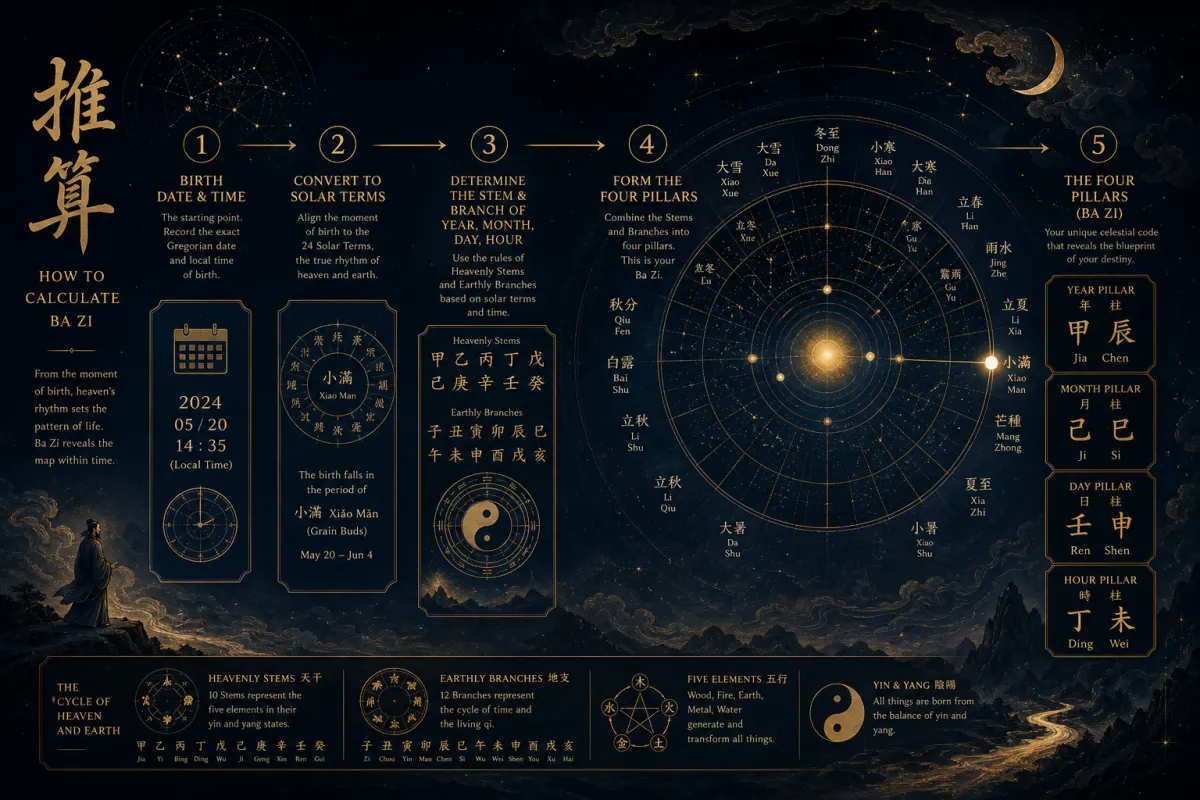
There are four steps: confirm date type and time context, set the Month Pillar by solar terms, set Year and Day by the stem-branch calendar, then set the Hour Pillar by birth hour. Even with a calculator, check these four points.
First: which calendar are you using?
Most people remember the solar (Gregorian) date; some remember the lunar date. Professional charting follows solar terms and the stem-branch calendar, not a raw lunar date treated as Ba Zi.
If you only have a lunar birthday, convert to the matching solar moment first. Births near Spring Festival or term boundaries are where day mistakes happen most.
Birthplace time zone can also shift true local time. When uncertain, mark the uncertainty instead of faking precision.
Year and Month: solar terms matter more than 'February'
The Year Pillar usually changes at Start of Spring (Li Chun), not at Chinese New Year or January 1.
Month Pillars follow the twelve solar terms: Yin month begins at Li Chun, Mao at Jing Zhe, and so on. A Gregorian February is not automatically a Yin month.
Many hand-calculation errors live on these boundaries. With a calculator, confirm it switches months by solar terms, not by civil months.
Day and Hour: land the clock time
The Day Pillar follows the stem-branch day sequence. The Day stem is the Day Master.
The Hour Pillar comes from the two-hour branch: Zi, Chou, Yin, and the rest. Change the hour, and later-life, children, and some details can change with it.
Births near 11 p.m. need care about day-boundary rules. Keep the real clock time visible when schools disagree.
If you use a Ba Zi calculator
An online calculator handles term conversion and pillar generation. Your job is accurate input: date, hour, gender, and date type.
After generation, verify four things: possible Li Chun year shift, month across a term, which stem is the Day Master, and whether the Hour Pillar matches the hour you entered.
If the hour is approximate, compare neighboring hours. Shared conclusions are safer; divergences deserve caution.
After calculation, what next?
Getting the eight characters finishes calculation, not interpretation. Next come Day Master, month command, Five Elements, Ten Gods, and luck-cycle starts.
Many people searching 'how to calculate Ba Zi' actually want 'how to read it afterward.' Keep calculation and analysis as separate steps.
For self-understanding or planning, accurate pillars plus structured reading beat staring at eight characters and guessing luck.
How to Get Started
- 1Prepare solar birth date, hour, gender, and location context.
- 2Check Li Chun, solar-term, and Zi-hour boundaries.
- 3Generate pillars and verify year/month by solar terms.
- 4Confirm Day Master and Hour Pillar against your input.
- 5If hour is fuzzy, compare neighboring hours.
- 6Only then move into strength, Ten Gods, and luck-cycle reading.
Common Mistakes
- Changing the year at Spring Festival instead of Li Chun.
- Setting the month by civil calendar month.
- Entering a casual hour while demanding hour-level precision.
- Mixing lunar and solar dates.
- Thinking calculation alone equals a full reading.
Try the Tool
Ba Zi — Four Pillars
Chart Ba Zi with solar or lunar dates and optional true solar time — Four Pillars, Five Elements, Ten Gods, and Major Luck Cycles, plus AI analysis on demand.
FAQ
A reliable online calculator—if your inputs are accurate and you verify solar-term boundaries.
Yes for the first three pillars, but Hour Pillar themes will be incomplete.
Related Reading
Online chart
Should you use true solar time?
Leap lunar months in Ba Zi
Uncertain Birth Hour
Ba Zi — Four Pillars
Chart Ba Zi with solar or lunar dates and optional true solar time — Four Pillars, Five Elements, Ten Gods, and Major Luck Cycles, plus AI analysis on demand.
Zi Wei Dou Shu
Generate your Zi Wei chart — twelve life palaces, star placements, and an AI interpretation of your destiny blueprint.
Name Analysis
AI name generation and analysis — supporting baby names, brand names, and personal name insights.