Ba Zi Basics
What Is Ba Zi?
Ba Zi turns the moment you were born into four pillars of stems and branches—eight characters that map character, career, relationships, and timing.
TianJiGe Editorial TeamUpdated
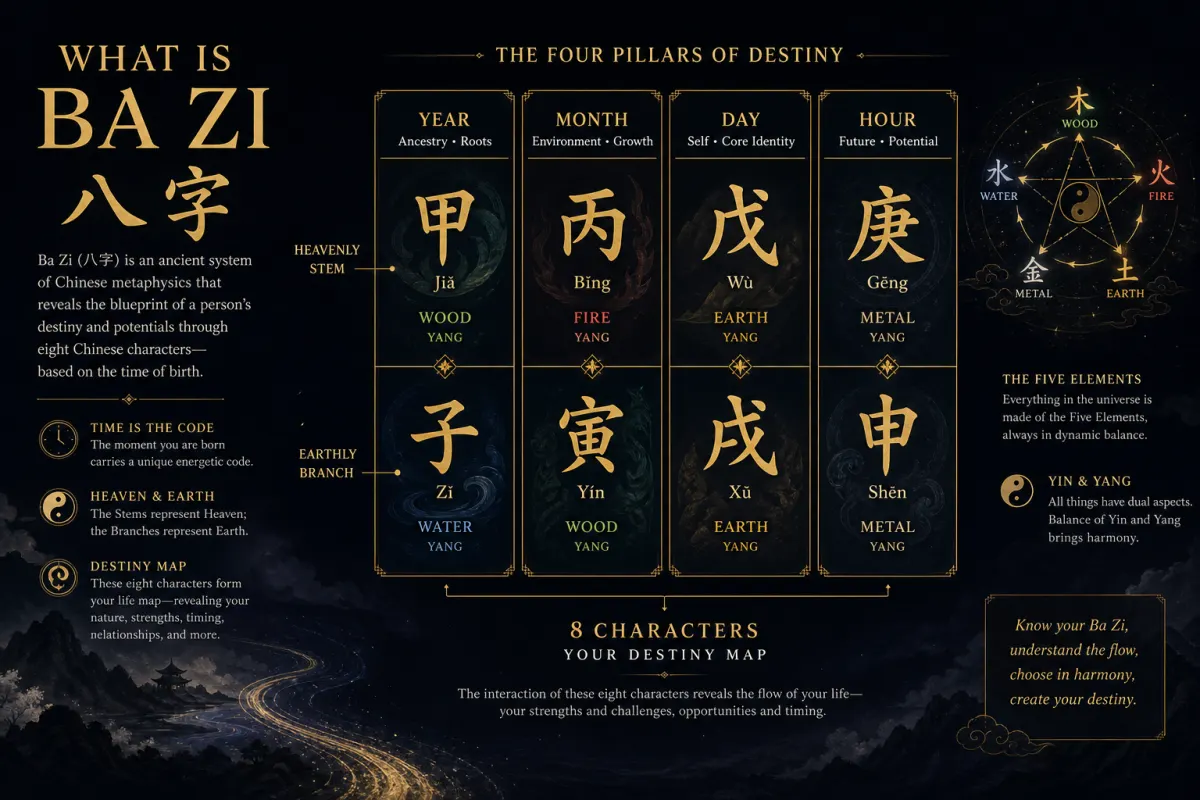
Ba Zi is not your animal sign and not a Western sun sign. It is Year, Month, Day, and Hour pillars—each a Heavenly Stem and Earthly Branch—eight characters in all. Start by knowing where those characters come from and what each pillar tends to show.
Which eight characters?
Ba Zi means Four Pillars: Year, Month, Day, and Hour. Each pillar has one stem and one branch, eight characters total.
If a chart reads Jia-Zi, Bing-Yin, Wu-Wu, Gui-Hai, those eight characters are the Ba Zi. The Day stem (Wu here) is the Day Master—you—and everything else is read relative to it.
Do not confuse Ba Zi with the animal year alone. Same year, different month, day, or hour can produce very different charts.
What each pillar tends to show
Year leans toward early background and family climate. Month connects to growth environment and career roots, because the month command is central to strength.
Day is closest: the Day stem is you; the Day branch often touches intimacy and inner state. Hour leans toward later output, children themes, and how results land.
Beginners need not treat each pillar as a rigid script. First see the chart as a structure, then chase labels.
How it differs from zodiac and sun signs
Animal signs are year-branch buckets. Western sun signs are broad temperament sketches. Ba Zi places the birth moment into the stem-branch calendar and solar terms.
Two people born in a Dragon year can still differ sharply—one Wood-strong and pioneering, another Earth-heavy and steady—because month, Day Master, and combinations decide more than the animal name.
For a light mirror, signs are fine. For career stages, relationship timing, and luck cycles, Ba Zi has finer resolution.
How people usually read it
Find the Day Master, read the month command and Five Elements, translate Ten Gods, then check when luck cycles activate themes.
Ba Zi can show tendencies in character, pace, resources, and why some stages feel busy, heavy, or ready for change. It describes structure and trend, not scripted lines.
If you are new, generate a free chart first, then learn Day Master, elements, and Ten Gods before asking whether fate is 'good'.
Common misunderstandings
Missing an element does not always mean you must add it. A harsh-sounding star is not automatically bad. Reading without birth hour and demanding fine marriage or children detail overstates what three pillars can hold.
Another trap is treating Ba Zi like a show that owes you one verdict. The useful path is translating structure into observations you can check in real life.
The chart is a mirror, not a sentence. It shows rhythm; you still choose.
How to Get Started
- 1Understand Ba Zi as four pillars and eight characters.
- 2Find the Day Master after charting.
- 3Read month command and elemental climate.
- 4Use Ten Gods to map life themes.
- 5Bring in luck cycles for timing.
- 6Verify conclusions against lived reality.
Common Mistakes
- Equating Ba Zi with the animal year alone.
- Judging from one character or symbolic star.
- Rushing to 'fix' every missing element.
- Demanding hour-level detail without birth hour.
- Treating the chart as an unchangeable verdict.
Try the Tool
Ba Zi — Four Pillars
Chart Ba Zi with solar or lunar dates and optional true solar time — Four Pillars, Five Elements, Ten Gods, and Major Luck Cycles, plus AI analysis on demand.
FAQ
Year, Month, Day, and Hour pillars—each a stem and a branch—make eight characters.
It is a Chinese astrology system that records birth timing in stems and branches to read structure, themes, and luck cycles.
Related Reading
Free Ba Zi Chart
How to Calculate Ba Zi
Day Master Explained
Ba Zi Analysis
Ba Zi — Four Pillars
Chart Ba Zi with solar or lunar dates and optional true solar time — Four Pillars, Five Elements, Ten Gods, and Major Luck Cycles, plus AI analysis on demand.
Zi Wei Dou Shu
Generate your Zi Wei chart — twelve life palaces, star placements, and an AI interpretation of your destiny blueprint.
Name Analysis
AI name generation and analysis — supporting baby names, brand names, and personal name insights.