Auspicious Hours
How to Read Auspicious Hours Today: 12 Two-Hour Periods & Daily Scheduling
Checking today's auspicious hours isn't about micromanaging every minute—it's about picking one calm, focused window in your day to start your most important conversation, submission, or decision.
TianJiGe Editorial TeamUpdated
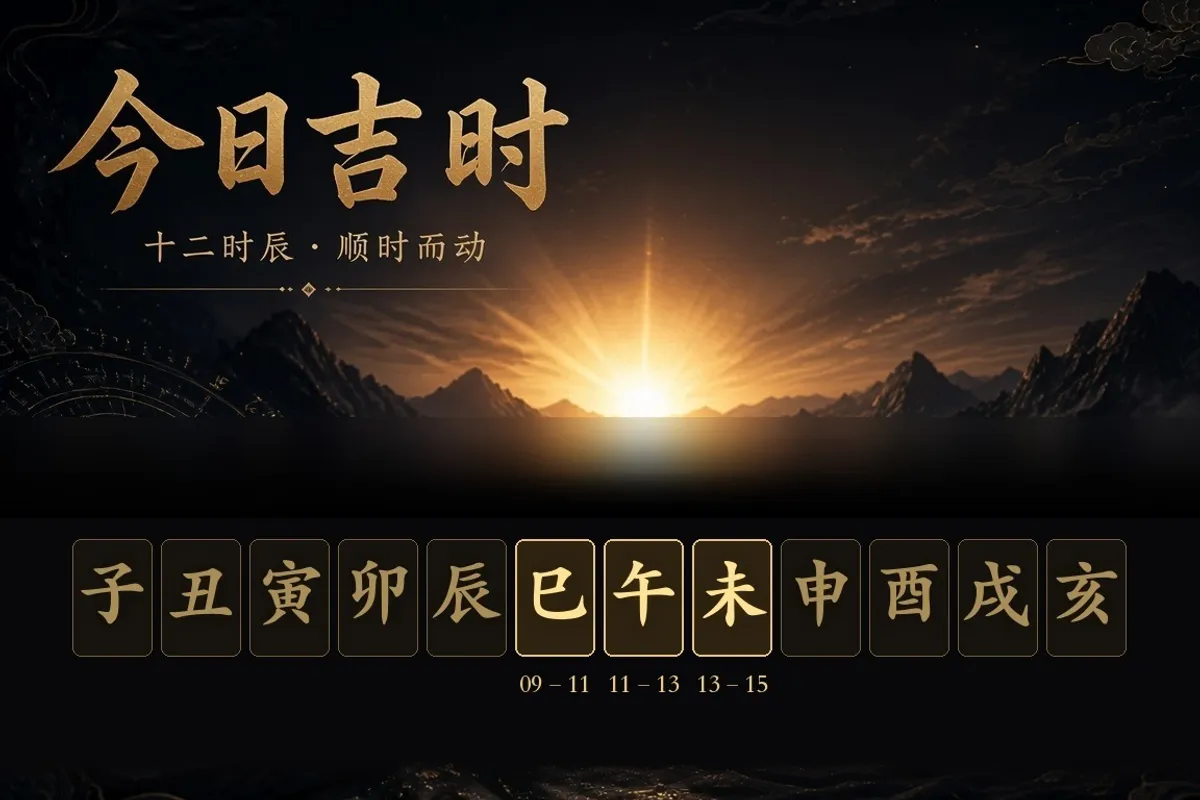
Map the traditional two-hour periods to modern clock time (such as Chen 7:00–9:00 or Si 9:00–11:00), pick a daytime auspicious window that does not clash with your zodiac sign to launch key tasks, and handle the rest of your schedule normally.
How daily auspicious hours are calculated
Traditional Chinese timekeeping divides the 24-hour day into twelve two-hour periods (Shi Chen), named after the twelve Earthly Branches from Zi (23:00–01:00) to Hai (21:00–23:00).
Each day's stem and branch rotate auspicious guardian stars across these twelve slots. When combined with your zodiac sign, the best windows are daytime hours that both carry auspicious stars and harmonize with—rather than clash against—your birth animal.
Quick clock guide to the daytime hours
Mao (05:00–07:00): Early departures and morning routines; Chen (07:00–09:00): Planning and kicking off the workday; Si (09:00–11:00): Peak mental clarity—ideal for presentations, signings, and focused work;
Wu (11:00–13:00): Midday connection and rest; Wei (13:00–15:00) & Shen (15:00–17:00): Great for negotiations, client calls, and sending proposals; You (17:00–19:00): Wrapping up and evening social plans.
Using auspicious hours on a normal workday
Pick just one priority action each day—sending an important pitch, signing an agreement, or initiating a delicate talk—and place its starting moment inside an auspicious daytime window.
Beyond traditional symbolism, this gives you a clear commitment anchor that prevents all-day procrastination.
What if a fixed meeting lands in an inauspicious hour?
Most work meetings, flights, and interviews are set by others. Never cancel a normal commitment over an hour label.
Instead, either complete your preparation or step out the door during an earlier auspicious hour, and treat the cautious hour as a cue to double-check details and speak with extra care.
Daily lucky hours vs. major life-event timing
Daily auspicious hours are light rhythm cues for everyday tasks. For weddings, moving in, or grand openings, choose the auspicious date first using the Date Selection tool, then pair it with the matching ceremonial hour.
How to Get Started
- 1Check today's fortune in the morning to see which daytime hours are highlighted.
- 2Pick the single most important action on your to-do list today.
- 3Avoid the two-hour period that directly clashes with your zodiac sign.
- 4Start or submit that key task within the auspicious window.
- 5If a meeting time is fixed outside a lucky hour, prepare ahead and slow your pace.
Common Mistakes
- Staying up past midnight just to use a late-night auspicious hour.
- Canceling important appointments because the hour is not marked lucky.
- Checking auspicious hours for trivial errands all day long.
- Ignoring your own zodiac clash when picking a generic almanac hour.
- Relying on a lucky hour without preparing the actual work.
Try the Tool
Daily Fortune
Quick daily reading with luck scores, lucky colors, lucky numbers, and action tips based on your zodiac sign.
FAQ
The almanac shows the general rhythm for the day, while zodiac fortune filters those hours through your birth sign's harmonies and clashes.
Skip it and sleep well. A rested mind during a normal daytime hour beats an exhausted action at 3 a.m.
Go Deeper
Today's fortune is just the start
Daily fortune reads today's rhythm. Your Ba Zi chart reads your character, career, wealth, and long-term cycles. Enter your birth details and get your chart in about a minute.
Related Reading
Today's Fortune
How to Read Daily Luck
Grand Opening Date Selection
Zi Hour in Ba Zi
Daily Fortune
Quick daily reading with luck scores, lucky colors, lucky numbers, and action tips based on your zodiac sign.
Auspicious Date Picker
Browse the Chinese almanac — find the best dates for moving, weddings, business openings, and more.
Ba Zi — Four Pillars
Chart Ba Zi with solar or lunar dates and optional true solar time — Four Pillars, Five Elements, Ten Gods, and Major Luck Cycles, plus AI analysis on demand.