Face Reading Basics
How to Read a Face: Three Zones and Features
Face reading isn't about staring at one spot for a verdict—it's reading the balance of the three zones, how the features echo one another, and the living layer of complexion.
TianJiGe Editorial TeamUpdated
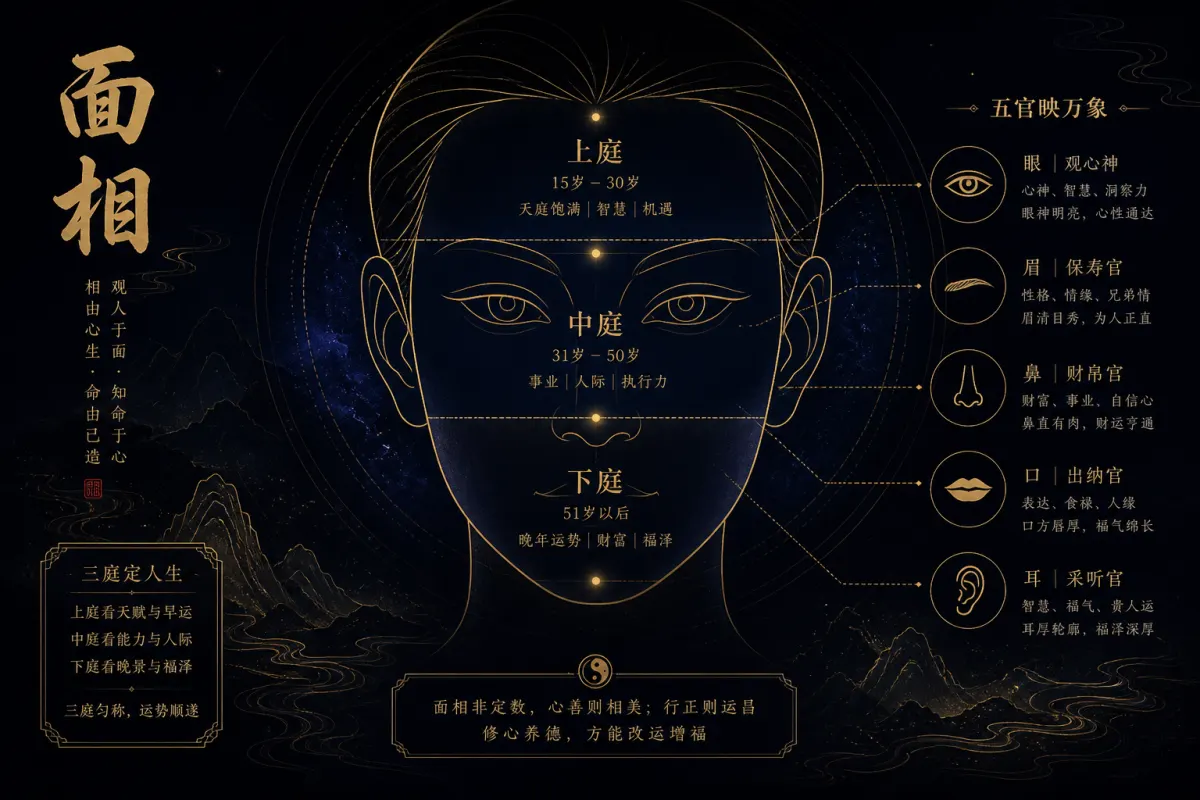
Divide the face into upper, middle, and lower zones and read the proportion; then move through forehead, brows, eyes, nose, mouth, and chin. Upload a clear, front-facing photo and let the AI connect these traits into one reading.
Three zones first, then features
Split the face into three zones: hairline to brow, brow to nose tip, nose tip to chin. Roughly balanced zones often matter more than any single striking feature.
Only then come the features—forehead for early years and thought, brows and eyes for temperament and rapport, the nose for self and wealth, mouth and chin for later years and will.
A longer upper zone often reads as open early thinking; a fuller middle zone, stronger mid-life drive; a heavier lower zone, steadier will later on. When zones look uneven, read them with the features—and check whether the photo angle is honest.
What each feature speaks to
The forehead reflects youth and openness of mind; brows and eyes lean toward emotion, character, and how you relate to others; the nose, the face's central peak, ties to self, drive, and resources.
Mouth and chin lean toward expression, appetite, and later life. But read each one back into the whole face—matching a single trait to a fixed verdict tends to miss.
Nose and mouth are often read together: how you speak, ask, and hold what you gain. When brows and eyes are alive and nose-mouth feel steady, the whole face usually reads more coherent.
Complexion is the living layer
Bone structure and features are the foundation; complexion is the light moving over it. The same face reads worlds apart bright versus dull.
Rather than chase fixed omens, treat face reading as a mirror for knowing yourself—a clear, settled look is itself a good sign.
Complexion shifts with season, sleep, and mood. Rested skin looks brighter; chronic stress tightens the eyes and dulls the lips. Read it as current state, not a permanent label.
Photo quality matters
Face reading depends on proportion. High or low angles, side views, close wide-angle selfies, and filters distort forehead, nose, and chin.
For AI reading, use natural light, a front-facing shot, eyes level with the camera, and no heavy beauty filter.
Half a face, a hidden hairline, sunglasses, or a mask can break the upper and middle zones. Before you shoot, check that hairline, brows, nose wings, and mouth corners are fully visible.
Read the person with their state
Sleep loss, stress, and low mood change complexion and expression. Rest and emotional steadiness can visibly change the face's feel.
Face reading is not a life stamp. It reads structure, current state, and habits together.
Long pressure can pull the mouth down and dull the gaze. Those layers sit on top of bone structure, so the same face can read differently across life stages. Use it as a reminder of where to rest, speak up, or recover your energy.
How to Get Started
- 1Prepare a clear, evenly lit, front-facing photo with nothing covering the face.
- 2Split the face into three zones and feel the overall proportion.
- 3Read the forehead, brows, eyes, nose, mouth, and chin in turn.
- 4Add complexion, gaze, and recent state.
- 5For a more connected view, let AI face reading weave it into one reading.
Common Mistakes
- Fixating on one mole or line to call fortune.
- Dim light or odd angles that distort the features.
- Treating a face as an unchangeable fate.
- Using beauty filters or wide-angle selfies for serious reading.
- Ignoring how sleep, stress, and mood affect complexion.
Try the Tool
Face & Palm Reading
Upload a photo and let AI analyze your facial features and palm lines for a personalized reading.
FAQ
Getting started is approachable. Learn the three zones and main features first, then the details; with AI help, even a first-timer can follow along.
Aim for front-facing, even light, and features not hidden by bangs or glasses; bare or light makeup helps identify basic traits.
Related Reading
Reading the Three Palm Lines
Mole Reading and Meanings
Face & Palm Reading
Upload a photo and let AI analyze your facial features and palm lines for a personalized reading.
Ba Zi — Four Pillars
Chart Ba Zi with solar or lunar dates and optional true solar time — Four Pillars, Five Elements, Ten Gods, and Major Luck Cycles, plus AI analysis on demand.
Zi Wei Dou Shu
Generate your Zi Wei chart — twelve life palaces, star placements, and an AI interpretation of your destiny blueprint.