San Cai Guide
How to Read Three Talents (San Cai) in Chinese Naming
While the Five Grids score individual positions, the Three Talents (San Cai) read how the Heaven, Person, and Earth grids flow together as an elemental chain.
천기각 콘텐츠팀업데이트
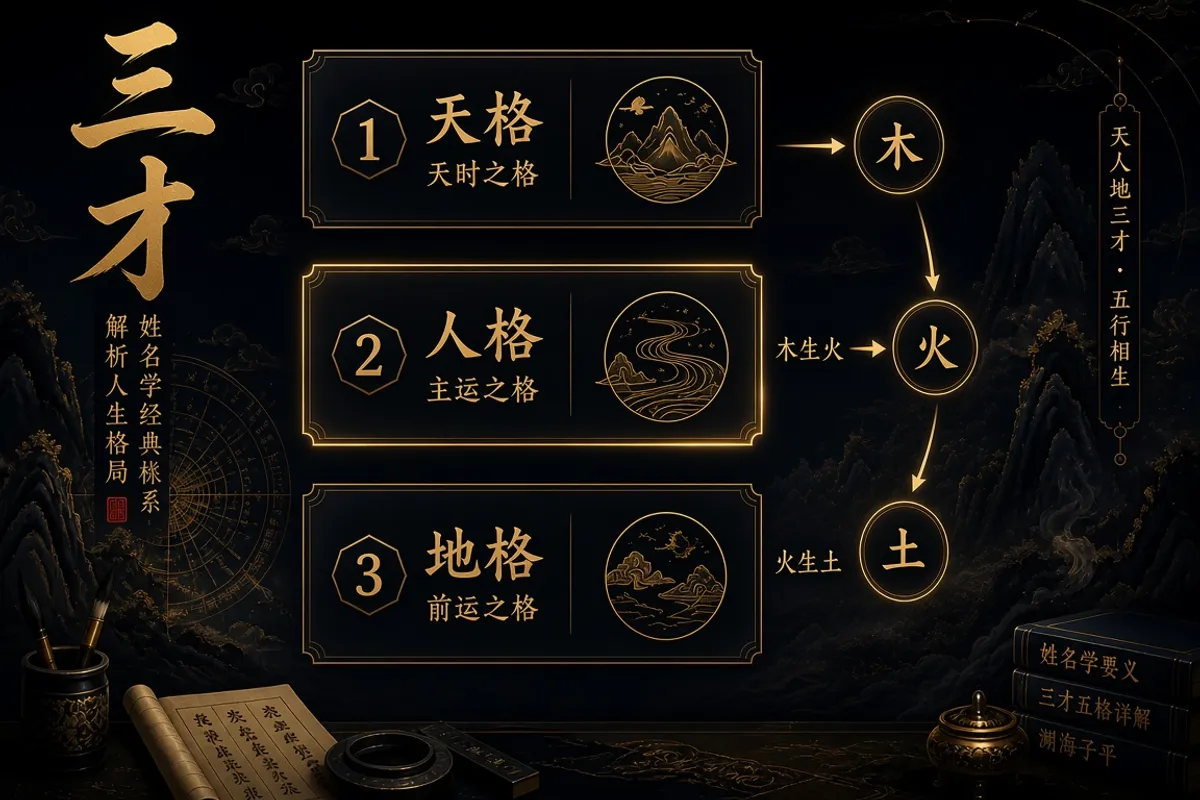
Calculate the stroke counts of the Heaven, Person, and Earth grids, convert each last digit into its element (1–2 Wood, 3–4 Fire, 5–6 Earth, 7–8 Metal, 9–0 Water), and check whether the upper and lower grids support or clash with the central Person Grid—using it as a secondary structural filter after meaning, sound, and Ba Zi.
What the Three Talents (San Cai) represent
Within Five Grid numerology, the Heaven Grid (surname heritage), Person Grid (core self), and Earth Grid (early foundation and home) form the 'Three Talents' (San Cai).
Rather than looking at each grid score in isolation, San Cai examines the vertical relationship among the three—asking whether energy flows smoothly through the center or collides.
How stroke counts convert into San Cai elements
San Cai elements are not based on character radicals; they come strictly from the last digit of each grid's stroke count:
1, 2 = Wood; 3, 4 = Fire; 5, 6 = Earth; 7, 8 = Metal; 9, 0 = Water.
For example, Heaven 12 (2 = Wood), Person 23 (3 = Fire), and Earth 15 (5 = Earth) form a 'Wood–Fire–Earth' chain where Wood feeds Fire and Fire feeds Earth.
Reading generation, harmony, and control around the Person Grid
The central Person Grid is the anchor of San Cai:
Mutual generation (such as Wood–Fire–Earth or Water–Wood–Fire) is traditionally favored for smooth support from elders and family.
Same-element harmony (such as Wood–Wood–Fire) reads as steady and focused.
Direct clashes against the Person Grid (such as Water–Fire–Water or Fire–Metal–Fire) are traditionally read as requiring more self-reliance and resilience.
San Cai elements vs. Ba Zi favorable elements
Because your surname is fixed, the Heaven Grid element cannot be changed. If chasing a textbook San Cai chain forces you into awkward characters or contradicts your child's Ba Zi favorable element, prioritize meaning, pronunciation, and Ba Zi direction.
Use San Cai as a tie-breaker among candidates that already sound great and carry warm meaning.
Should you change an existing name over a San Cai clash?
No need to panic. Stroke-based numerology depends on dictionary conventions (Kangxi traditional vs. modern simplified strokes) and is only one lens.
If your name sounds natural, writes cleanly, and serves you well in daily life, a low San Cai label alone is no reason to go through the cost of legally renaming.
시작하는 방법
- 1Calculate the stroke counts for the Heaven, Person, and Earth grids.
- 2Convert each grid's last digit into Wood (1–2), Fire (3–4), Earth (5–6), Metal (7–8), or Water (9–0).
- 3Check whether the Heaven and Earth grids generate, match, or control the central Person Grid.
- 4Prioritize meaning, pronunciation, written balance, and Ba Zi favorability first.
- 5Use San Cai to choose the smoothest structure among your top name candidates.
흔한 오해
- Confusing last-digit grid elements with character-radical Five Elements.
- Picking rare or awkward characters just to force a 'generating' San Cai chain.
- Abandoning Ba Zi favorable directions because the surname's Heaven Grid is fixed.
- Worrying over an existing name that works well in real life.
- Mixing simplified and Kangxi traditional stroke counts across different tools.
도구 열기
이름풀이
AI 작명과 이름 감정 — 아기 이름, 브랜드 이름, 내 이름의 의미를 알아보세요.
자주 묻는 질문
By the last digit of the Heaven, Person, and Earth grid stroke counts: 1–2 Wood, 3–4 Fire, 5–6 Earth, 7–8 Metal, 9–0 Water.
Inside numerology they work together, but in real-world naming, character meaning, sound, writing ease, and Ba Zi alignment come first.