Palmistry · Career
How to Read the Career Line in Palmistry
The Career Line (also called the Fate Line) runs vertically up the center of the palm toward the middle finger—reflecting your sense of purpose, responsibility, and how your work focus evolves over time.
천기각 콘텐츠팀업데이트
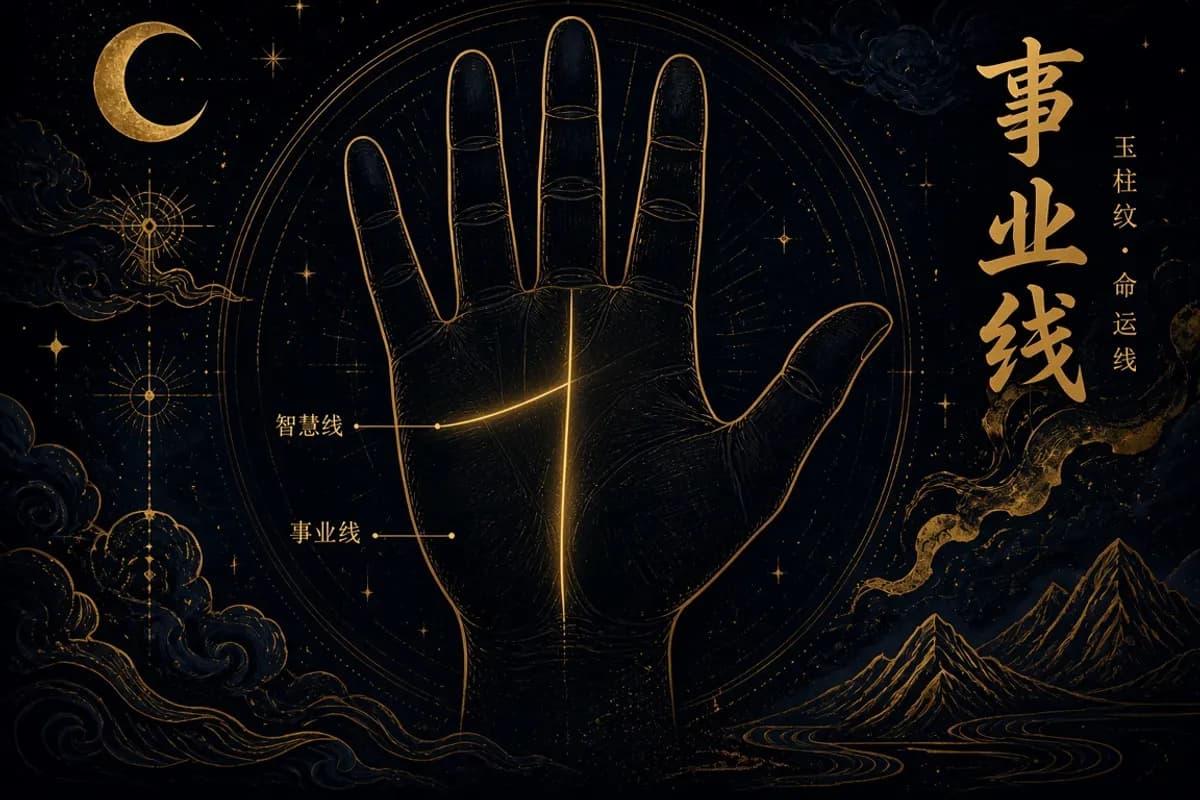
Look for the vertical line rising toward the base of the middle finger, note where it starts and whether it shifts or overlaps across the Head Line, and always read it together with the Head Line—remembering that an absent Career Line simply means a flexible path, not a lack of success.
Where the Career Line sits and what it actually measures
While the Heart, Head, and Life lines are the three primary palm lines, the Career Line (traditionally called the Jade Pillar Line or Fate Line) is the vertical line rising from the lower palm toward the base of the middle finger (Mount of Saturn).
Rather than measuring a fixed salary or job title, it reflects how strongly you anchor yourself to long-term goals, structured responsibilities, and a chosen role.
What if you have no visible Career Line?
Many successful professionals have clear Heart, Head, and Life lines with no prominent vertical Career Line at all.
An absent or faint Career Line does not mean you will have no career. It usually means you are adaptable, less tied to a single rigid institutional track, or guided more by curiosity and your Head Line (intellect and judgment) than by lifelong routine.
Conversely, someone with a very deep Career Line often feels a strong need to stay busy and shoulder responsibility—even outside formal employment.
Starting points: Self-made drive vs. external connection
Rising straight from the center near the wrist: Suggests early independence and a self-reliant, step-by-step work style.
Branching out from the Life Line: Often points to strong family ties early on and steady progress built through personal perseverance.
Slanting up from the outer palm (Mount of Moon): Traditionally associated with careers shaped by public interaction, creativity, travel, or supportive networks.
Breaks, overlaps, and parallel lines: Career pivots in modern life
In modern palmistry, a break in the Career Line—especially when a new line starts beside it to carry the path upward—rarely means ruin; it typically marks a career pivot, industry switch, relocation, or second act.
A line that grows deeper after crossing the Head Line (roughly mid-thirties) often reflects finding your true professional stride after early exploration.
Always pair the Career Line with the Head Line
The Career Line shows drive and commitment; the Head Line shows how you think, plan, and solve problems.
A clear, balanced Head Line can carry your career far even if the Career Line is light, while a heavy Career Line paired with a tense Head Line is a reminder to pace yourself and work smarter rather than harder.
시작하는 방법
- 1Open both palms naturally in even light and locate the Heart, Head, and Life lines first.
- 2Look for the vertical line rising through the center of the palm toward the middle finger.
- 3Note its starting point and how its depth changes as it crosses the Head Line and Heart Line.
- 4Compare your left and right hands to see innate tendency versus current work rhythm.
- 5Upload a clear palm photo to let AI palmistry read the Career Line together with your primary lines and mounts.
흔한 오해
- Assuming no visible Career Line means you will never succeed at work.
- Panicking over a break or overlap that simply reflects a normal career transition.
- Reading the Career Line in isolation while ignoring the Head Line.
- Cupping or tensing the hand so normal skin folds look like deep fate lines.
- Checking only one hand without comparing both.
도구 열기
관상·손금
사진을 올리면 AI가 얼굴의 특징과 손금을 분석해 맞춤 풀이를 드립니다.
자주 묻는 질문
Not at all. The Career Line is a secondary line. Many accomplished people have no strong vertical line and thrive through a strong Head Line and adaptable work style.
Usually it reflects a shift in direction—such as changing industries, moving cities, returning to study, or shifting focus between work and family—especially if another line continues upward nearby.