Name Analysis
Five Grid Name Numerology Explained
Five Grid numerology reads a name's structure through stroke counts—but it's only one reference among several in naming.
TianJiGe Editorial TeamUpdated
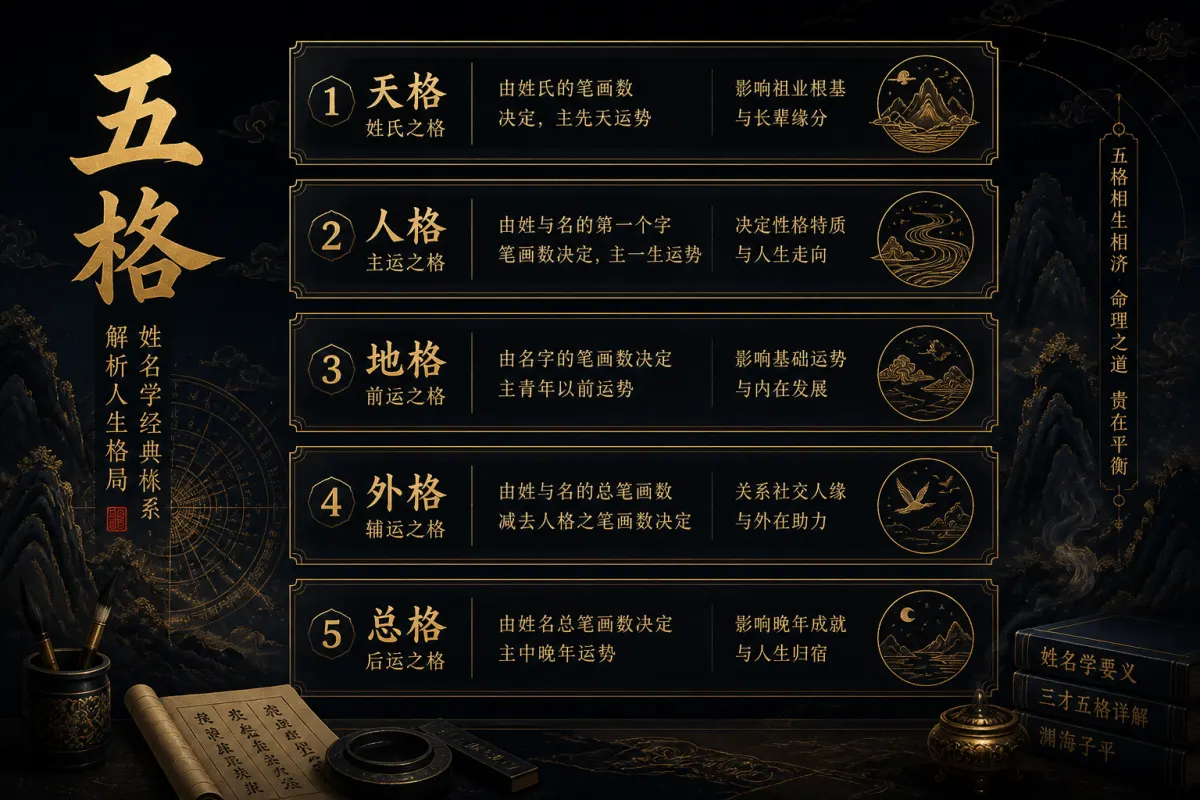
Take the Heaven, Personality, Earth, Outer, and Total grids as references, but don't let a high score crowd out meaning, sound, writing, and real use.
What the five grids stand for
The Heaven Grid ties to the surname and what is inherited; the Personality Grid is often read as the center; the Earth Grid speaks to early foundations.
The Outer Grid reflects how you meet the outside world; the Total Grid draws the whole name together.
Do not read only one grid. A strong Personality Grid cannot rescue a name that sounds awkward, means little, or feels unbalanced overall.
Three Talents and Five Grids
The Three Talents usually refer to the Heaven, Personality, and Earth relationship, read for structural flow and support.
The Five Grids give a wider breakdown: inherited surname, core personality, early base, outer interaction, and total picture.
Both are structural references. They should sit beneath Ba Zi direction, meaning, sound, form, and everyday usability.
Why a score is not enough
Stroke counts shift with character sets, simplified-versus-traditional standards, Kangxi strokes, and tool-specific dictionaries.
A high-scoring name that sounds awkward or means little may not serve well in everyday life.
Use Five Grids to screen candidates and catch extreme structures, not to let the highest number decide everything.
Why tools disagree
Many naming systems use Kangxi strokes, while modern tools may use simplified strokes, traditional strokes, or custom dictionaries.
The same character can receive different stroke counts, so the grid result changes.
When comparing tools, keep the stroke standard consistent before drawing conclusions.
How it pairs with Ba Zi
If traditional naming matters, read Ba Zi and the Five Elements first, then use the Five Grids as a filter.
Ba Zi gives the direction: clearer, warmer, steadier, softer, more open. Five Grids check whether the name structure is extreme or relatively smooth.
The final name should still honor meaning, sound, form, and family preference.
Using Five Grids to shortlist names
Start by removing names with awkward sound, poor meaning, hard writing, or embarrassing homophones.
Then use Five Grids to compare the remaining candidates. A medium-scoring name with excellent meaning and use may be stronger than a high-scoring but clumsy one.
This keeps numerology helpful without letting it run the whole decision.
How to Get Started
- 1Calculate the Heaven, Personality, Earth, Outer, and Total grids.
- 2Confirm which stroke standard the tool uses.
- 3Read the Five Grids and Three Talents for extreme patterns.
- 4Check the result against Ba Zi and elemental direction.
- 5Filter again by sound, meaning, writing, and homophones.
- 6Use the score as a helper, not the final judge.
Common Mistakes
- Chasing nothing but a high score.
- Overlooking simplified, traditional, or Kangxi stroke differences.
- Picking a thin-meaning name because the number looked good.
- Reading only the Personality Grid.
- Letting grids outrank Ba Zi, meaning, and real use.
Try the Tool
Name Analysis
AI name generation and analysis — supporting baby names, brand names, and personal name insights.
FAQ
It's a naming reference, not the sole standard.
It's often read as central, but the whole name matters.
Related Reading
Baby Naming with Ba Zi
Ba Zi Five Elements
Name Analysis
AI name generation and analysis — supporting baby names, brand names, and personal name insights.
Ba Zi — Four Pillars
Chart Ba Zi with solar or lunar dates and optional true solar time — Four Pillars, Five Elements, Ten Gods, and Major Luck Cycles, plus AI analysis on demand.
Daily Fortune
Quick daily reading with luck scores, lucky colors, lucky numbers, and action tips based on your zodiac sign.