Compatibility Score
How to Read a Compatibility Score
A compatibility score is a quick overview of a relationship—but the dimensions behind it matter far more than the number itself.
TianJiGe Editorial TeamUpdated
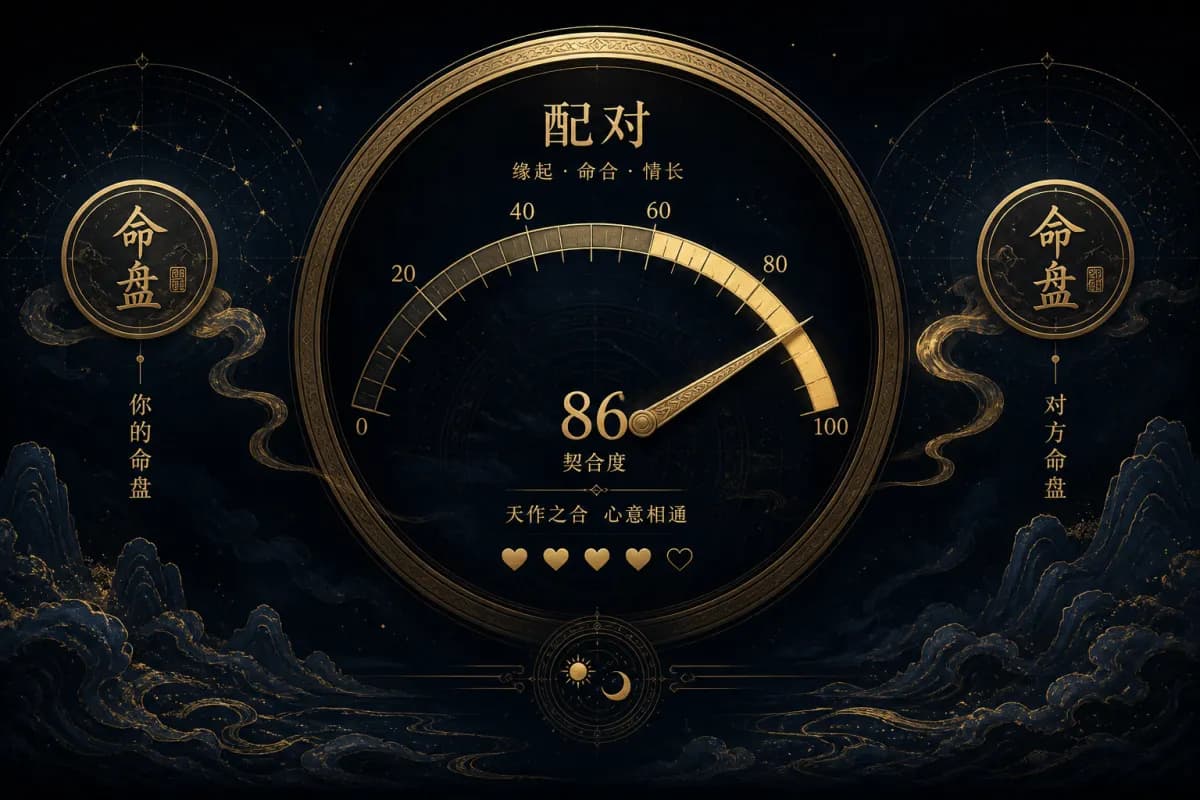
Use the score to get oriented, then read which dimensions are strong and which ones still need work.
Where the score comes from
It may combine zodiac, Day Master, spouse palace, Five Elements complement, Na Yin, and partner stars.
Together these reflect attraction, stability, complement, pressure, and how you will get along over time.
Zodiac and Na Yin are outer affinity; Day Masters and spouse palaces touch daily relating; elements show support or drain; partner stars show whether relationship needs are visible.
The total is only the entrance
An 85-point match may be balanced, or it may hide one weak dimension under several strong ones. A 65-point match may be dragged down by one specific issue.
Use the total score for orientation, not for marriage or breakup decisions.
The dimension pattern matters more: strong attraction but weak stability calls for different work than steady compatibility with poor expression.
A high score vs. a low one
A high score suggests more traditional support, though conflict can still show up through communication, family pressure, or money habits.
A low score points to clearer friction, not an impossible relationship.
Its value is diagnostic: does the friction come from rhythm, emotional style, values, family, or unwillingness to compromise?
Why the advice matters
The score is the overview; the advice tells you what to strengthen and what to sidestep.
Some couples have strong attraction but shaky stability; others are steady yet hold their feelings back.
If money is the weak spot, talk budget and risk. If communication is the weak spot, agree on repair after conflict.
When the score is most useful
For a very new connection, read the score lightly. It should not replace actually knowing the person.
When a couple is discussing marriage, families, living together, buying a home, or children, the score can help surface long-term topics.
If a relationship keeps repeating the same fight, the dimensions can help name the pattern underneath it.
Turn the score into a conversation checklist
Turn each dimension into a question: how do we handle money, family, conflict, distance, security, and personal space?
The score is not a verdict. It is closer to a relationship checkup.
What lasts is not the number itself, but whether both people are willing to face the issues and build workable rules together.
How to Get Started
- 1Read the total score.
- 2Check every dimension behind it.
- 3Find whether the weak spot is attraction, stability, complement, communication, or rhythm.
- 4Read the main friction point fully.
- 5Turn the advice into a concrete conversation.
- 6Compare it with the real quality of the relationship.
Common Mistakes
- Reading the number and nothing else.
- Rejecting a relationship over a low score.
- Brushing off real issues because the score is high.
- Ignoring which dimension caused the score.
- Using the score instead of talking honestly.
Try the Tool
Love Match
Six-dimension marriage compatibility from both BaZi charts with AI relationship guidance.
FAQ
Find the weak dimension, then work on communication, boundaries, rhythm, or values.
There's no fixed line. What matters is whether the strengths are enough to hold up the weak spots.
Related Reading
Ba Zi Compatibility Test
Love Match
Six-dimension marriage compatibility from both BaZi charts with AI relationship guidance.
Ba Zi — Four Pillars
Chart Ba Zi with solar or lunar dates and optional true solar time — Four Pillars, Five Elements, Ten Gods, and Major Luck Cycles, plus AI analysis on demand.