Day Master
How to Judge Day Master Strength
Day Master strength asks one question: does the self element get enough support in this chart? It is the gateway to finding favorable elements—and the step most often done wrong.
TianJiGe Editorial TeamUpdated
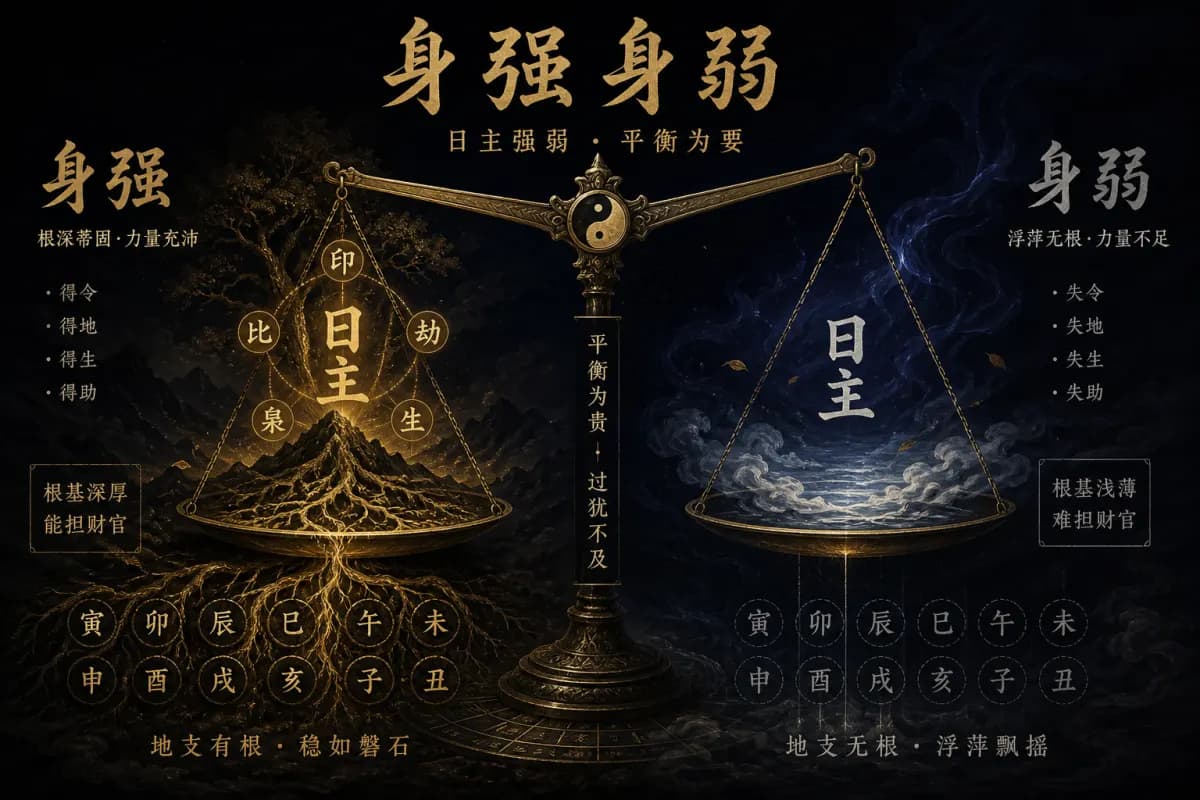
Judge strength by three checks: does the Day Master match or receive the month command, does it have roots in the branches, and do Resource and Peer stars support it? More yes means stronger. Strength itself is neither good nor bad—it tells you what the chart needs.
What strong and weak really mean
The Day Master stands for you. A strong Day Master receives ample same-element and generating support; a weak one is outweighed by controlling and draining forces. It describes structure, not fortune.
Think of a strong chart as a powerful engine that needs a road and a load, otherwise the energy turns restless. A weak chart is a light vehicle that needs fuel and care, and suffers most under constant heavy load.
The point of judging strength is the next question: does this chart need output and regulation, or support and reinforcement?
Step one: the month command
The month branch carries the season's dominant energy and weighs most in the judgment. A Day Master matching or generated by the month command starts ahead.
Wood born in spring is in season; Wood born in autumn, when Metal dominates, starts discounted.
Simply counting elements while ignoring the season is the most common source of error. One element in command of the month can outweigh three scattered elsewhere.
Step two: roots in the branches
Roots are same-element hidden stems in the branches. With roots, the stem's power lands; without them, it floats.
Roots differ in weight: the day branch sits closest, the month branch carries most force, and main-qi roots outweigh minor ones.
A rootless Day Master, even surrounded by peer stars in the stems, is a plank floating on water—busy on the surface, unable to bear weight.
Step three: support versus drain
Sort the Ten Gods into two teams: Resource and Peers support the Day Master; Officers, Output, and Wealth consume it. Their balance is the direct reference.
This is weighing, not counting: characters near the Day Master matter more, in-season characters weigh more, and combined-away or clashed characters are discounted.
If the two sides come out roughly even, the chart may be near-balanced or need finer analysis—no need to force a label.
How strength shows up in life
Strong charts often bring decisiveness and pressure tolerance, but also stubbornness and overreach. They usually welcome Output, Wealth, or Officer elements to channel the force.
Weak charts often bring sensitivity, adaptability, and skill at borrowing strength, but also worry and hesitation. They usually welcome Resource and Peer support first.
These are tendencies, not verdicts. A weak chart can rise in the right cycle; an unbalanced strong chart can struggle.
Why this decides favorable elements
The classical support-restrain method rests entirely on this judgment: strong charts favor drain and control, weak charts favor support. Get strength wrong and every later suggestion flips.
Names, career direction, and timing advice all trace back to this step.
If unsure, chart first, walk the three checks yourself, then compare with a full analysis and its reasoning.
How to Get Started
- 1Generate the full chart and identify the Day Master.
- 2Check whether it matches or is generated by the month command.
- 3Look for roots among the hidden stems, weighing their position.
- 4Compare supporting stars against draining and controlling ones.
- 5Adjust for proximity, season, and combinations.
- 6Only then move on to favorable elements.
Common Mistakes
- Counting elements while ignoring the month command.
- Reading weak as unlucky.
- Reading strong as harsh or domineering by default.
- Ignoring how combinations and clashes change real strength.
- Adding elements before strength is settled.
Try the Tool
Ba Zi — Four Pillars
Chart Ba Zi with solar or lunar dates and optional true solar time — Four Pillars, Five Elements, Ten Gods, and Major Luck Cycles, plus AI analysis on demand.
FAQ
No. Strength is a structural tendency that decides what the chart needs; it does not equal good or bad fortune.
You can make a first pass with the month command, roots, and support. Near-balanced or heavily combined charts are easy to misjudge, so verify with a full reading.
Related Reading
Useful God in Ba Zi
Day Pillar Reading
Free Ba Zi Chart
Ba Zi — Four Pillars
Chart Ba Zi with solar or lunar dates and optional true solar time — Four Pillars, Five Elements, Ten Gods, and Major Luck Cycles, plus AI analysis on demand.
Zi Wei Dou Shu
Generate your Zi Wei chart — twelve life palaces, star placements, and an AI interpretation of your destiny blueprint.
Name Analysis
AI name generation and analysis — supporting baby names, brand names, and personal name insights.